
I. Introduction: Understanding the neuroscience of investing is essential for any disciplined investor
We all know the golden rules of investing: “buy low, sell high,” “diversify,” and “time in the market beats timing the market.”
As engineers and investors, we analyze dividends, reports, and yields with surgical precision. But the moment the market crashes and our charts turn red, that logic often evaporates. Why do we lose our cool exactly when we need it most?
The answer isn’t a lack of study; it’s biology. Our brains evolved to survive in the wild—fleeing predators, not navigating stock market volatility. To build wealth at constructyield.com, we must accept that our biology often works against us. Let’s understand how fear “hijacks” our logic and how to build safety mechanisms for both our minds and our portfolios.
II. The Biology of Fear: Your Brain on a Rollercoaster
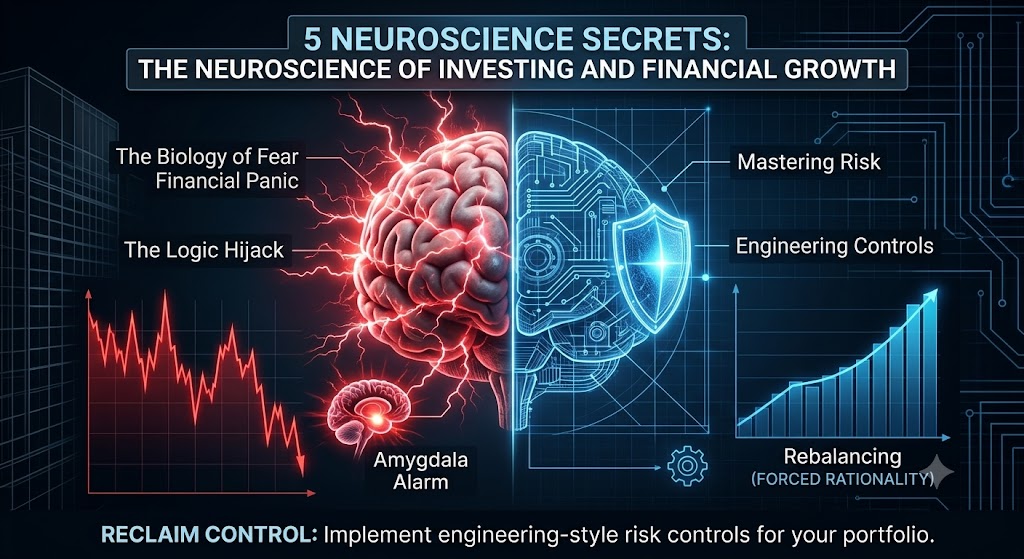
To understand why investors panic, we need to look at two brain regions: the Amygdala and the Prefrontal Cortex. Understanding the neuroscience of investing helps us decouple our emotional responses from market data.
The Amygdala Alarm: Think of the amygdala as your built-in alarm system. It is the emotional center that triggers “fight or flight.” When you see your portfolio drop, your amygdala interprets it as a life-or-death threat, flooding your brain with cortisol, the stress hormone.
The Logic Hijack: As cortisol spikes, it inhibits your prefrontal cortex—the part of the brain responsible for long-term planning and logic. This is why, under pressure, we make irrational decisions, like selling quality assets simply because their price dipped momentarily.
The “Pain” of Loss vs. The Pleasure of Gain
A cornerstone of behavioral economics is Loss Aversion, a concept developed by psychologists Daniel Kahneman and Amos Tversky. Science shows that the psychological pain of losing $1,000 is, on average, twice as intense as the joy of gaining $1,000.
Essentially, our brains are hardwired to be overly cautious. While this kept us alive in the Stone Age, in investing, it causes us to flee the market just when it offers the best entry points.
III. The Dopamine Loop: The “Eternal Creator of Needs”
If fear paralyzes us, dopamine drives us down the wrong path. As the neurotransmitter of “reward,” dopamine is released whenever we anticipate a gain or something new.
The Consumption Trap: Our brain doesn’t distinguish between the long-term satisfaction of investing and the immediate thrill of buying a new gadget. Marketing thrives on this: a new purchase gives you a dopamine spike, but it is fleeting.
Sabotaging Your Savings Rate: This cycle of “creating needs” is the enemy of your investment capacity. When you divert money meant for income-generating assets (like your REITs) into immediate consumption, you are trading your “future self” for a temporary dopamine fix today.
The neuroscience of investing confirms that our biological reward system is easily distracted by immediate consumption. When we apply the neuroscience of investing to our daily habits, we break the cycle of impulsive consumption.
IV. Why Risk is Necessary (And Why Fear Misinterprets It)
In finance, there is a vital distinction between Risk and Uncertainty.
Risk vs. Uncertainty: Risk is something we can measure and manage (like volatility). Uncertainty is the unknown, which triggers our amygdala. Fear makes us treat volatility as an absolute danger.
The Risk of Not Taking Risks: If you keep your capital idle in a bank out of fear, you face the biggest risk of all: inflation. Over time, inflation silently erodes your purchasing power, turning your “safety” into a constant loss. We must trade the comfort of inertia for calculated risk to build real wealth.
This paradigm shift is central to the neuroscience of investing, allowing us to perceive volatility as a tool rather than a threat.
V. Mastering Risk: “Safety Rails” for Your Brain
In engineering, we manage risks through redundancy and fail-safes. We can’t change our amygdala, but we can build systems to prevent our emotions from destroying our portfolio:
Asset Allocation (The Structural Concrete of Your Wealth): Think of your portfolio as a building. Asset allocation is your reinforced concrete project: it dictates how much weight each pillar (asset class) must support. Without a plan, a market “earthquake” makes your favorite pillar crack, and panic makes you want to tear down the whole building.
With a set allocation—e.g., 60% REITs, 30% Fixed Income, 10% Cash—you don’t make panic decisions. If REITs drop 20%, your Fixed Income pillar remains solid. Allocation turns market chaos into a predictable exercise of redistributing “load” instead of abandoning the project.
Rebalancing (The Automatic Circuit Breaker): Rebalancing is the ultimate “automated control system.” When an asset rises significantly, you sell the excess (forcing yourself to take profit). When it falls, you buy more (forcing yourself to buy the dip). It is engineering forcing rationality during moments of instability.
Practical Protocol: What to do when an asset falls?
Don’t freeze. Follow this three-step audit:
- Fundamental Audit: Was the drop caused by market noise or a structural change in the investment thesis? If dividends and management remain solid, the drop is just a market event.
- The “Stress Test” (New Money vs. Rebalancing):
- If fundamentals are intact: do not sell. If the drop left your asset underweight compared to your target allocation, use your next monthly contribution to buy more at this “discount,” lowering your average cost.
- If the thesis is broken: only then should you consider reallocating.
- Avoid “Portfolio Churning”: Selling an asset in a dip just to chase a hot trend is the classic error of letting the amygdala take the wheel. Sell only if the original thesis is fundamentally broken.
- Long-Term Focus (The Prefrontal Override): Automate your investments and avoid checking your portfolio daily. At constructyield.com, the focus is on the income stream (yield), not daily price noise. If the asset keeps delivering expected dividends, price volatility is merely statistical noise.
VI. Conclusion: Building Your Financial Fortress
At the end of the day, successful investing isn’t about being a genius who predicts the market; it’s about being a disciplined manager who understands their own limits. You don’t need to delete your fear; you just need to build structures that render your emotional reactions harmless.
By understanding the mechanisms behind every decision, you stop reacting emotionally and become the architect of your own wealth. Mastering the neuroscience of investing is the ultimate competitive advantage for the modern wealth builder.